A Train Trip from San José to Limón in the 20th Century
Memoria # 6
A Train Trip from San José to Limón in the 20th Century
Memoria # 6

During at least the decades between 1900 and 1950, the daily passenger train of the Northern Railway Company left San José for Limón at 9:00, and at 10:15 the characteristic whistles of the engineer could be heard, announcing the passage of the convoy and its next arrival in Cartago.
When leaving San José, if one sat on the right side, next to a window, it was interesting to see the coffee plantations, intermittently shaded by frequently pruned poró trees. At that time, semi-shaded mountain coffee was considered the best quality arabica.
The train made short stops at the intermediate stations of Herrán and Sánchez, before Tres Ríos. Afterwards one had to be patient while the train mounted a long slope with a black, curved bridge, towards El Alto de Ochomogo. It was called Puente de Fierro (Iron Bridge) because from the high bridge you could see the railroad ties painted with coal tar nailed to the track, which rose gently and stood out against the green of the narrow valley it traversed.
On El Alto, the Northern Company had placed a prominent sign right at the highest point, with the inscription:
CONTINENTAL DIVIDE
DIVISION CONTINENTAL
ALTITUDE 5500 FEET 1676METERS
In fact, in this place the rainwater ran east to the Atlantic watershed, or else, west to join the rivers that flowed into the Pacific.
Beginning the descent to the east, the rails defined one border of the Bosque de Aquiares, composed of native trees in a small, narrow valley that had begun to form, and in whose depths were springs of crystalline water that was taken by pipes to the city of Cartago. The volume of this water was supplemented by other water brought from heights slightly above El Alto, but belonging to the Pacific watershed. The civil engineer don Ramón Picado drew or traced the levels where each section of pipe should go, to cross the continental divide and thus to join the watershed towards Cartago. My father was a friend of don Ramón, and when I was a boy he took me along [to visit don Ramón]. On two walls of the engineer’s parlor were a number of black-and-white photographs of the conduits, already placed in a line, where they would be buried. They were still not in their place; I studied them in detail. This memory has remained clear for me all these years, and, in retrospect, it seems to me that it was an astute and intelligent project.
The train’s short, five-to-ten-minute stop in Cartago was enough for the boarding of passengers and the loading to the caboose of baskets of vegetables destined for the cities of the tropical zone. Also, for the bizcocho
sellers to cry, “Bizco ocho …bizco o ocho …” These braids of crusty dough were made of yellow corn, salt, and some shortening, perhaps originally butter, and more recently, margarine. It is still a popular product, particular to Cartago, where it is still in demand.
When the stationmaster, don Enrique Moya, rang his bell three times, the train started, and glided rapidly to the east. Soon it arrived at El Inalámbrico [a wireless station]. Its high towers, with six cables hung three and three, were the means by which the Cia. Radiográfica Costarricense
[Costa Rican Telegraph Company] could send its messages abroad, called “cables.” My father used cables for business matters, and for private family matters also.
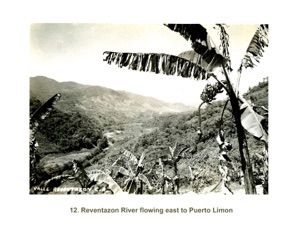
Paraíso was the next station, with a short stop; then the train went on to Tucurrique, where there was a double track, to allow a train to stand while another train arrived from the opposite direction. Here they sold the famous pejibayes, already cooked and salted, of Tucurrique, a village on the other side of the valley formed by the Reventazón [river]. The pejibaye (Guilelma gasipaes), which is the fruit of a palm tree, is floury when cooked; with a little salt, this layer of 1 to 2 cm., between the skin and the small nut, has a subtle, appealing taste. To relieve the dryness of it, some people fill the hollow left by the seed with mayonnaise or the like, when it is served at the table.
Arriving two hours later at Turrialba was a relief, as it was an important stop at the easternmost city in the province of Cartago. In those days there was the Hotel Roma, my father’s favorite; he knew the proprietor, don Jaime Marín. Turrialba was still a zona de bajura [lower zone] for coffee production, intermittently watered by the rains that drained into the Turrialba River, an important tributary of the Reventazón. The riverbed in Turrialba was very wide, for in storms, the torrents eroded the margins of the riverbanks in the curves, and in summer, wide areas covered with tumbled stones could be seen. The railway bridge [over the river] had two support bases to sustain the structure, which consisted of two arches of iron beneath the rails.
In 1938, my mother, doña Lena, spent the months of January and February in Turrialba with my sister Sarita and me (the author), so that she could benefit from the warmer climate, which should relieve the arthritis in her hands. We took walks, a favorite activity of my mother, and once we went to the finca [farm] La Dominica, whose American proprietors, Mr. Cook and his sister, she knew. There I met for the first time a very special guest, Mr. Claude Hope. They called him “El Capitán,” since he had this rank in the U.S. Navy [marina], and he apparently wanted to move to Costa Rica on retirement. He was very fond of ornamental plants, and adept at raising them. A while later, he built some greenhouses, covered with plastic, partly because of the heavy rains, and also to raise the temperature, and promote the rooting of the seedlings and the rapid growth of the plants. These greenhouses were built near Dulce Nombre de Cartago, where he could contract for the necessary labor.
Many years later, when I returned to Costa Rica on one of my trips as an official of IICA, a friend took me to Linda Vista, which was the name of Captain Hope’s establishment. I spent a short time with him; he remembered me as Neto, and asked me to sit next to him. Less than a year later, I got the sad news of his death, from cancer. He was buried, according to his wishes, in the cemetery of Dulce Nombre.
Going back to the story of the railway stations, the next one was Peralta, with a double track, to allow crossing with the train from Limón to San José. The tunnel of Peralta, 1 to 2 km. long, went through a solid hill that bordered the Reventazón. The foresighted passengers lowered their windows, to dilute the smoke from the engine that crept over the wagons. In those stretches, it was hair-raising to see the turbulent river nearly beside the track, which was anchored in the solid rock of a cliff, on a ledge dug with picks and shovels. Visualizing the slow descent of the rail line from the highlands to the lowlands, one notes the ingenious plan for using the riverbanks and the valley to guide the railway’s gradual loss of altitude.
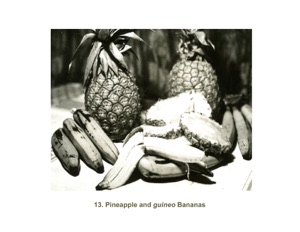
On crossing the last bridge, the tracks turned sharply to the north, and leaving the banks of the river, started across the plain, where the city of Siquirres waited. The memorable feature of this stop was the tall women who, carrying on their heads trays of freshly sliced fruit, offered “Piñaa …Piñaaah” to the passengers leaning from the train windows.
La Junta [station] followed after a short distance; it was the point of intersection with the branch of the Linea Vieja [Old Line], the railway leading to Guapiles, located on the north side of Volcán Turrialba. In this region, exploitation of the virgin forests had begun, with trees whose wood was very desirable for its durability and its attractive vein. We recall the cedro amargo and the very hard, reddish wood called cocobolo. From the latter were made vessels of various forms, and later on, sculptors created unique designs [with its wood]. After the exploitation of the forests, they began to plant great expanses of pineapple, which the United Fruit Company exported to North America.
My mother, doña Lena, had a friend, Mrs. Tennyson, whose husband’s job was to supervise pineapple plantations. My mother was invited by Mrs. Tennyson to visit at her house in La Colombiana, and she took me along. I remember that we were taken for a ride in a car with a roof, and benches, that they called a “trolley.” Two huge laborers moved a lever up and down, to propel the car. They took us to the end of a plantation, where I saw for the first time, from 200 meters away, the virgin forest of the plain formed by the foothills of the Cordillera Central, to the north. There I was impressed by the immense, tall trees, many with epiphytes, and the scant vegetation below them, which tolerated less light. In these fields, workers toiled among the pineapples, but I was too young to notice in detail what they were doing.
Back at La Junta, you could board the train to Limón. There, on the flat plain, the train ran faster, and made small local stops only if a white flag indicated that there were passengers. Three long whistles from the engineer of the passenger train warned people to get off the tracks, which were used by residents of small towns to walk from one place to another. There were no proper roads, and one saw much poverty.
Following the route towards the coast, one crossed lowlands whose residents were obliged to build their houses on stilts; sometimes water was standing in the surrounding area.
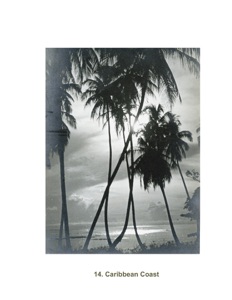
Then came the small station of Moin, where you could already see bits of the beach, or the coral reefs, between the palm trees. Some hillocks appeared, and suddenly a higher hill, with headstones and tombs seeming to lean slightly to the east. This was the cemetery of Limón. It was said that the railway company put on a small engine to pull two or three rail cars, forming a funeral cortège. This point could be clarified by historians, or people who lived then.
The first streets and blocks of the city came into view, and in five to ten minutes more, the train made a triumphal entrance, on the tracks nearest to the station building. Shortly, the train approached the platform of the port, and stopped to discharge passengers.
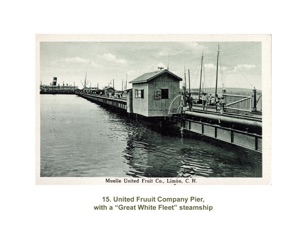
On very special occasions, the train had as its last car the “Carro Oficial,” with special seats, where dignitaries or high-ranking officials traveled. It was pulled by a small engine to Pier No.1, which belonged to the United Fruit Company white steamship anchored there. It carried passengers in cabins on the top one or two levels, and its main cargo was the stalks of bananas in the hold.
I remember one time when I, a child about twelve, visited my Papá, who had been transferred to Limón by the Compañia Bananera de Costa Rica [United Fruit Company]. With him I stood at Pier No. 1, awaiting the arrival of the “Carro Oficial,” which would be towed alongside one of the white passenger steamers that the United Fruit Company called “The Great White Fleet.” The steamer on duty that day was the Ulua, named for one of the main rivers of Central America, whose names the Company gave to its ships. On this special occasion, the official car carried the President of the Republic, Ricardo Jimenez Oreamuno, who was traveling to the USA with his wife, doña Beatríz. There were many people on the pier, waiting to see the retinue. Don Ricardo and his wife began to walk through the passage that remained open, when from one side of the walkway emerged my father, a great admirer of don Ricardo. He took off his straw hat – a formal hat, as was used by gentlemen of the time – and bowing to don Ricardo, extended his hand in a gesture of greeting. Don Ricardo had doña Beatríz on his right, and, I think, a cane in his left hand, which made it difficult for him to return the handshake. He had been elected for the third time, and it was in this period that he finally married.
In the first years of the century [1900’s], Limón became Costa Rica’s most important Atlantic city. Its Parque Central had trees that looked 100 years old, especially the gomeros (Ficus sp.), whose branches and foliage met overhead. From the paths, looking into the canopy of these trees, one could make out, with patience, several perico ligeros [sloths, also called perezosos], that stretched out their hands, from their strange hanging position, to pluck the most tender shoots of leaves to eat.
The city-port had several other special points of interest. Near the Parque Central was another smaller one, called Parque Vargas. It had only straight-trunked palm trees, whose bases were painted white, giving them a noticeable touch of distinction.
The tajamar, or sea-wall, was a solid construction that bordered the city waterfront and afforded a clean view of the Atlantic on one side, and also the nearby Isla Uvita, directly to the east. The ocean was deep between the continent and the island, such that the steamships headed north took that route, as could be seen from the sea-wall, until they disappeared in the distance, growing smaller and smaller, seeming to show the effect of the curvature of the earth.
The Mercado Central [Central Market] of Limón, brimming with tropical products like yuca, camote, ñame, piña, and with other products from higher altitudes, was another point of interest in the city. If one headed south, crossing a wooden bridge, there was a sort of estuary where gigantic turtles were raised. These were cruelly shipped alive in the steamships to North America. Further on, one could walk along the black sand shore, between the breaking waves and the scrub and palm trees.
Heading north, a green, well-tended area was clearly seen; it was La Zona, where the United Fruit Company had a hospital and houses for its high-level employees. The Company doctor was Dr. Antonio Facio, an eminent surgeon, much loved for is wisdom and dexterity. When he went to live in San José, he was considered one of the most distinguished doctors at the Clinica Biblica. My parents arranged that I should have my tonsils removed by Dr. Facio; the patient [the author] was10 or 12 years old.
The Compañia Bananera [UFC] brought from Jamaica a good number of men to work on its plantations. Their families, and, later on descendants, populated Limón to a large extent. Some moved to the center of the country, getting a good education that permitted them to take important jobs.
In primary school, when they described to us the voyages of Columbus to the Americas, they said that, on his fourth and last voyage, he reached the area near Limón. According to the story, the Spanish exchanged trinkets for objects of gold made by the natives. The Spanish were so dazzled by the riches that the place was known as a rich coast, from which, we were told, came the name of the country, “Costa Rica.”
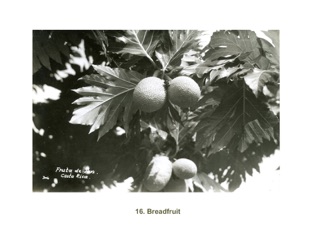
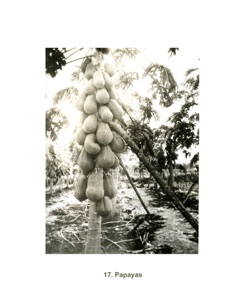
See Photos: 11, 12, 13, 14, 15, 16, 17